Essential Skills for the AI Age: Thriving in a World That Thinks

3 min read

1

The Landscape Is Shifting—And So Are Careers

AI is not a monolith that replaces jobs overnight. Instead, it transforms them—automating tasks, not entire roles. This opens space for new kinds of work, previously unthinkable, and breathes new purpose into existing careers. Take these real-world examples:

  • Radiologists now rely on AI to scan thousands of images, but their role becomes more strategic—communicating diagnoses, making nuanced decisions, and guiding treatment plans.

  • Writers using AI tools like ChatGPT or Sudowrite don’t lose creativity—they gain momentum, testing tone, headlines, or plot twists with instant feedback.

  • HR professionals use AI to sift through applications, but the emotional intelligence to assess team fit or resolve conflict? That’s still human territory.

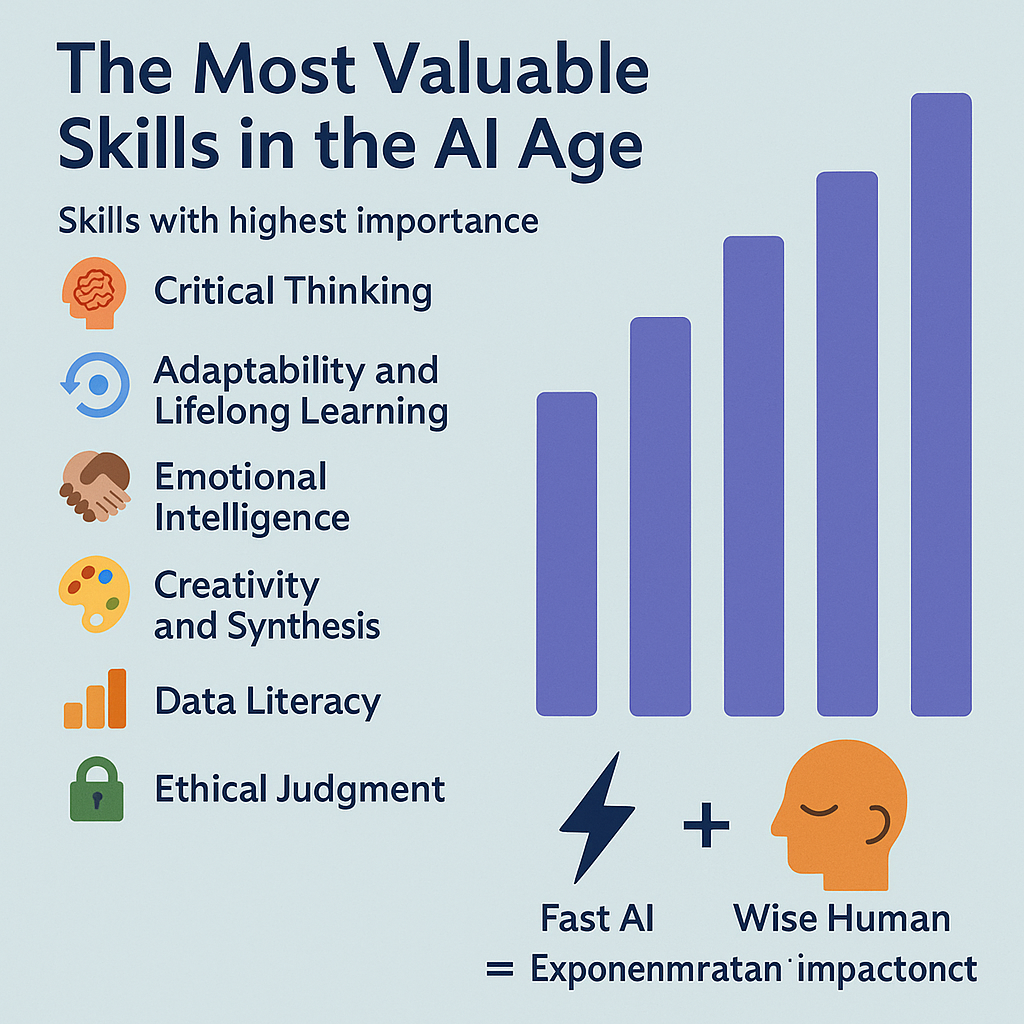
The Most Valuable Skills in the AI Age

Here are the skills—and the mindsets—that will matter most in a machine-augmented future:

🧠 1. Critical Thinking

When AI generates answers, we need humans to question them. Being able to spot bias, detect false logic, and ask the right questions becomes essential.

Why it matters: AI can make convincing mistakes—critical thinkers are the circuit breakers.

🌀 2. Adaptability and Lifelong Learning

Careers won’t be fixed ladders; they’ll be lattices. People will shift roles and reskill multiple times. Curiosity becomes a professional superpower.

Why it matters: The half-life of skills is shrinking. What you know today may be obsolete in five years.

đŸ€ 3. Emotional Intelligence

Empathy, negotiation, listening—skills AI still can’t fake. In leadership, healthcare, education, or customer service, human connection remains non-negotiable.

Why it matters: People follow people, not processes. Trust can’t be automated.

🎹 4. Creativity and Synthesis

AI can remix, but it can’t originate true vision or human insight. Being able to combine disparate ideas, imagine new paths, or tell compelling stories is future-proof.

Why it matters: AI is the tool—humans bring the why, the emotion, the surprise.

📊 5. Data Literacy

You don’t have to be a data scientist. But understanding how to read, interpret, and ask smart questions of data separates the passive from the powerful.

Why it matters: Informed decisions beat gut instincts—and AI depends on good data.

🔐 6. Ethical Judgment

AI makes decisions that affect lives. From self-driving cars to sentencing algorithms, we need humans to question outcomes, build fairness into systems, and hold the line.

Why it matters: Ethics isn’t a department. It’s a skill every worker must wield.

Emerging Professions in the AI Age

Not science fiction—real roles already on the rise:

  • AI Ethics Officer – Ensures fairness, transparency, and compliance in machine learning systems.

  • Prompt Engineer – Specializes in writing instructions for generative AI tools.

  • Human-AI Interaction Designer – Crafts intuitive interfaces for collaborating with AI.

  • Digital Twin Analyst – Builds virtual replicas of physical systems to simulate and optimize performance.

  • Data Translator – Bridges the gap between technical teams and decision-makers with clear insights.

The Human Edge: What Machines Can’t Replicate

Let’s be clear—machines are fast, accurate, and tireless. But humans bring meaning, values, and connection. The most valuable professionals will be those who combine human depth with machine speed.

[Fast AI + Wise Human] = Exponential Impact

A Realistic, But Optimistic Outlook

The AI age won’t be a golden utopia or a dystopian takeover—it will be what we make of it. Yes, some jobs will disappear. But many more will be reborn. Careers will evolve from static paths to dynamic journeys, and skills will be less about technical expertise alone and more about how you think, adapt, and relate.
Final Thoughts

Your job title may change. Your tools definitely will. But your ability to learn, connect, question, and create—that’s your edge. In a world of intelligent machines, being fully human is your greatest asset.

The AI age doesn’t belong to the bots. It belongs to the bold.

Latest Articles

How Career Paths Are Changing in the AI Era

Career paths are changing rapidly in the AI era as automation reshapes roles, skills, and progression models. This expert article explains how traditional career ladders are giving way to skill-based, non-linear paths driven by adaptability and continuous learning. With real examples from companies like IBM and Google, practical strategies, and clear comparisons, it helps professionals understand how to build resilient, future-proof careers by focusing on durable skills, problem ownership, and effective collaboration with AI systems.

Careers & Skills of Tomorrow

Read » 0

The Rise of Hybrid Human-AI Roles

Hybrid human-AI roles are redefining the future of work as organizations move from pure automation to human-AI collaboration. This expert article explains why hybrid roles are rising, how they differ from traditional jobs, and what skills professionals need to succeed alongside AI. Featuring real examples from companies like Microsoft, IBM, Salesforce, and Zendesk, it provides practical guidance on role design, governance, and performance measurement for sustainable careers in an AI-driven economy.

Careers & Skills of Tomorrow

Read » 0

Essential Skills for the AI Age: Thriving in a World That Thinks

We are living through a quiet revolution. Unlike the industrial booms of the past, today’s transformation doesn’t roar with machines or smoke—it hums through algorithms, speaks in code, and learns silently in the background. Artificial Intelligence isn’t coming for your job—it’s coming with your job. And that makes this moment not one of panic, but of potential. In the AI age, the value of being human is being recalibrated. The future won’t just reward what machines can’t do—it will reward those who can work alongside machines, augmenting intelligence with creativity, ethics, and adaptability. The question isn’t, “Will AI replace me?” but “How do I become irreplaceable in a world shaped by AI?”

Careers & Skills of Tomorrow

Read » 1

Soft Skills That Will Matter Most in 2030: The Human Edge in an AI-Driven World

In 2030, the workforce will look radically different. With AI, automation, and digital tools transforming industries, many jobs will evolve, and others may fade away entirely. However, there is one thing that machines will never replicate: the human touch. While technical skills will remain critical, soft skills—those less tangible, more interpersonal abilities—will define the future of work. These are the qualities that enable us to connect, collaborate, think critically, and lead with empathy. In a world where machines perform more of the transactional and routine tasks, humans will be expected to contribute value in ways that technology cannot. This shift will require us to hone a set of unique, essential skills that will be the hallmark of successful professionals in 2030. Let’s take a closer look at the soft skills that will matter most in the coming decade and explore why they’ll be the key to thriving in an AI-enhanced world.

Careers & Skills of Tomorrow

Read » 0

Skills Humans Will Need in an Automated World

Automation and AI are transforming work, but they also redefine which human skills matter most. This expert article explores the essential skills humans will need in an automated world, including judgment, critical thinking, creativity, ethical reasoning, and human-AI collaboration. With real examples from companies like IBM, Google, and Microsoft, it provides practical guidance for professionals preparing for long-term relevance in an AI-driven economy, focusing on durable skills that complement automation rather than compete with it.

Careers & Skills of Tomorrow

Read » 0

Learning How to Learn: The Key Skill of the Future

Learning how to learn is becoming the most critical skill in a rapidly changing world. As technology evolves and job requirements shift, the ability to acquire, adapt, and apply new knowledge efficiently determines long-term success. This in-depth guide explains what learning how to learn really means, why traditional education often fails to teach it, and how proven methods like active recall, spaced repetition, and problem-based learning can dramatically improve retention and skill transfer. Ideal for students, professionals, and lifelong learners.

Careers & Skills of Tomorrow

Read » 1