Summary
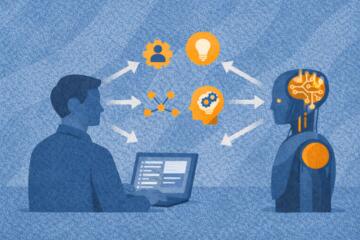
Hybrid human-AI roles are emerging as one of the most important shifts in the modern workforce. Instead of humans competing with machines, these roles are built around collaboration—where AI handles execution and scale, while humans provide judgment, context, and accountability. This article explains why hybrid roles are rising, where organizations struggle to implement them, and how professionals can position themselves for sustainable careers alongside AI.
Overview: What Hybrid Human-AI Roles Actually Are
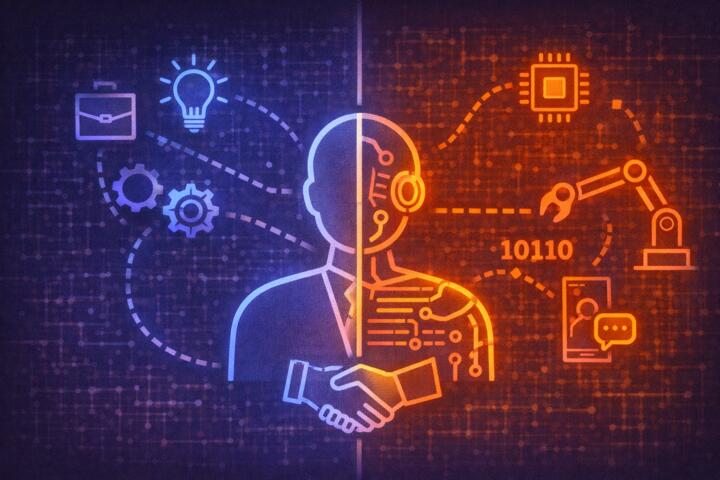
Hybrid human-AI roles are jobs where core performance depends on effective collaboration between a human and AI systems, not on either acting alone. These roles are not temporary transitions; they are becoming the default structure of work in many industries.
In a hybrid role:
-
AI handles data processing, drafting, prediction, and automation.
-
Humans guide objectives, validate outputs, manage exceptions, and take responsibility for outcomes.
For example, a modern financial analyst may rely on AI to generate forecasts and scenarios, but still decides which assumptions matter and which risks are acceptable. Similarly, marketers increasingly use AI to generate content variants while humans define strategy and brand direction.
According to the World Economic Forum, over 50% of employees will need significant reskilling by 2027, with hybrid skills—combining domain expertise and AI collaboration—among the fastest-growing requirements. Companies like Microsoft and IBM openly frame the future of work around “human-AI teaming” rather than replacement.
Main Pain Points in the Shift to Hybrid Roles
1. Treating AI as a Standalone Worker
Many organizations deploy AI tools as isolated solutions.
Why this matters:
AI without human context produces outputs that are technically correct but strategically wrong.
Real situation:
Teams generate AI reports faster, but decisions slow down because no one trusts or owns the results.
2. Undefined Role Boundaries
Hybrid roles fail when responsibilities are unclear.
Problem:
Who decides? Who approves? Who is accountable?
Consequence:
Errors scale quickly, and trust in AI systems collapses.
3. Skills Mismatch
Employees are trained either in domain knowledge or AI tools—but not both.
Impact:
AI adoption stalls because users do not know how to integrate outputs into real decisions.
4. Measuring Activity Instead of Impact
Organizations often measure:
-
AI usage,
-
number of tasks automated,
instead of outcomes.
Result:
Hybrid roles appear productive but do not deliver business value.
Solutions and Practical Recommendations
Redesign Roles Around Human Strengths
What to do:
Explicitly assign:
-
AI → execution, pattern recognition, scale
-
Humans → judgment, prioritization, ethics, accountability
Why it works:
Clear division prevents overlap and confusion.
In practice:
In legal teams, AI drafts and summarizes contracts, while lawyers approve terms and assess risk.
Train for Human-AI Collaboration, Not Tool Usage
What to do:
Teach employees how to:
-
ask better questions,
-
interpret AI outputs,
-
spot errors and bias,
-
decide when to override AI.
Tools used in practice:
AI copilots embedded in productivity suites and analytics platforms.
Result:
Teams trained in collaboration—not just tools—show 20–40% higher productivity gains.
Embed AI Directly Into Workflows
What to do:
Integrate AI where decisions happen:
-
CRMs
-
analytics dashboards
-
project management tools
Platforms enabling this shift:
-
Salesforce (Einstein AI)
-
Google Workspace AI
Why it works:
Context-aware AI produces more reliable outputs.
Establish Human-in-the-Loop Governance
What to do:
Define escalation rules for:
-
financial impact,
-
legal risk,
-
customer-facing changes.
Outcome:
Hybrid systems scale safely without removing human responsibility.
Measure Hybrid Performance End-to-End
What to do:
Track:
-
decision quality,
-
cycle time,
-
error reduction,
-
customer impact.
Why it works:
Hybrid roles succeed only when measured on outcomes, not activity.
Mini Case Examples
Case 1: Hybrid Customer Support Roles
Company: Zendesk
Problem: Support agents overloaded with repetitive tickets
Solution:
AI handles classification, drafting, and routing; humans resolve edge cases and manage tone
Result:
-
Resolution time reduced by 25–30%
-
Higher customer satisfaction scores
Case 2: Hybrid Knowledge Work in Consulting
Company: IBM
Problem: Analysts spent excessive time on manual research
Solution:
AI summarizes documents and generates drafts; consultants validate insights
Result:
-
Faster project delivery
-
Reduced junior workload without quality loss
Hybrid Human-AI Roles: Comparison Table
| Dimension | Traditional Role | Fully Automated | Hybrid Human-AI Role |
|---|---|---|---|
| Execution | Human | AI | AI |
| Judgment | Human | Limited | Human |
| Accountability | Human | Unclear | Human |
| Scalability | Low | High | High |
| Adaptability | Medium | Low–Medium | High |
Common Mistakes (and How to Avoid Them)
Mistake: Replacing humans instead of augmenting them
Fix: Redesign roles to emphasize judgment and oversight
Mistake: Letting AI make final decisions
Fix: Keep humans accountable for outcomes
Mistake: Training only on tools
Fix: Train on interpretation, validation, and escalation
Author’s Insight
I’ve seen hybrid roles outperform both fully manual and heavily automated teams. The key difference is ownership: when humans remain accountable, AI becomes a powerful amplifier instead of a risk. The strongest professionals are not those who use AI the most, but those who know when to trust it—and when not to. Hybrid work rewards clarity of thinking more than technical novelty.
Conclusion
The rise of hybrid human-AI roles marks a structural change in how work is done. As AI takes over execution at scale, human value concentrates in judgment, coordination, and responsibility. Organizations and professionals who embrace hybrid design—rather than full automation or resistance—will achieve higher productivity, resilience, and long-term relevance.