Summary
Education systems worldwide are under pressure to produce job-ready graduates faster than ever. Traditional curricula focus on subjects and degrees, while skills-based education emphasizes measurable, practical competencies. This article explains how these two approaches differ, where each fails, and how institutions and learners can choose the model that delivers real career outcomes.
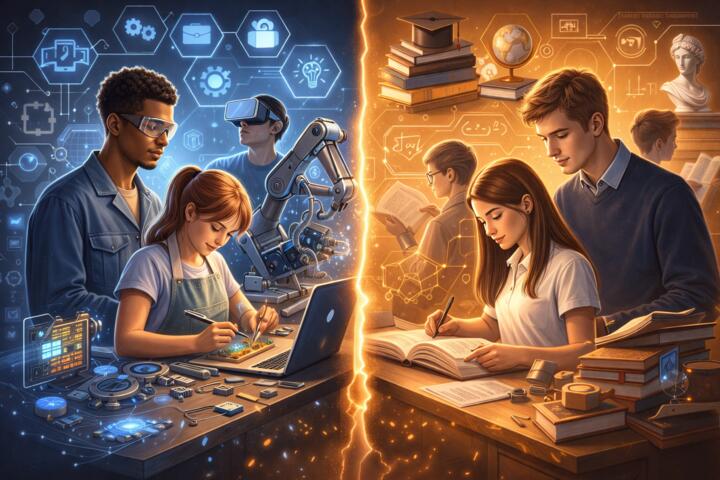
Overview: What Skills-Based Education Actually Means
Traditional education organizes learning around subjects, semesters, and credentials. Skills-based education reorganizes learning around competencies that can be demonstrated, assessed, and applied.
In practice, skills-based programs answer a different question:
“What can a learner do after finishing this program?”
According to workforce research cited by the World Economic Forum, over 50% of employees will need reskilling due to changing job requirements. This shift exposes the limits of purely theory-driven curricula.
Traditional Curriculum: Strengths and Structural Limits
Traditional education has strengths that should not be ignored:
-
strong theoretical foundations
-
standardized quality control
-
recognized credentials
However, it struggles to adapt to rapidly changing skill demands.
For example, a computer science graduate may understand algorithms but lack hands-on experience with modern cloud platforms, DevOps workflows, or data pipelines used by employers today.
Pain Points: Where Traditional Curriculum Breaks Down
1. Slow Curriculum Updates
University programs often update syllabi every 3–5 years.
Why this matters:
Industry tools change yearly.
Real outcome:
Graduates enter the workforce with outdated skills.
2. Overemphasis on Time, Not Mastery
Traditional systems reward seat time.
Problem:
Passing a course does not guarantee competence.
3. Weak Alignment With Labor Market Needs
Many programs are designed internally, with limited employer input.
Result:
A mismatch between graduate skills and job requirements.
4. Assessment Focused on Memory
Exams test recall more than application.
Consequence:
Students “learn to pass” rather than “learn to perform.”
5. Credential Inflation
Degrees are increasingly required for roles that do not need them.
Impact:
Barriers rise without improving productivity.
What Skills-Based Education Does Differently
Competency-First Design
What to do:
Define learning outcomes as skills, not topics.
Why it works:
Skills can be validated through tasks, projects, and performance.
How it looks in practice:
-
coding challenges instead of theory exams
-
real-world case analysis
-
portfolio-based assessment
Continuous Assessment Instead of Final Exams
Approach:
Assess learners throughout the program.
Result:
Feedback loops accelerate learning and reduce failure rates.
Platforms such as Coursera and Udacity rely heavily on skills-based evaluation through projects reviewed against rubrics.
Modular and Stackable Learning
What it means:
Skills are grouped into modules that can be combined.
Benefits:
-
flexible pacing
-
faster reskilling
-
clearer career pathways
This model supports lifelong learning rather than one-time education.
Strong Employer Involvement
What changes:
Employers help define skill frameworks.
Why it matters:
Programs align directly with hiring needs.
Companies increasingly value demonstrable skills over formal degrees in roles such as data analysis, UX design, and digital marketing.
Skills Transparency
Outcome:
Learners know exactly what they can do after each module.
Example:
Instead of “Completed Marketing 101,” a learner can demonstrate:
-
campaign analytics
-
A/B testing
-
audience segmentation
Mini-Case Examples
Case 1: Corporate Reskilling Program
Context:
A mid-size tech company faced skill gaps in cloud engineering.
Traditional approach:
External certifications with low completion rates.
Skills-based solution:
-
role-specific skill maps
-
project-based assessments
-
mentor feedback
Result:
-
time to productivity reduced by 35%
-
internal mobility increased
Case 2: Alternative Education Provider
Problem:
Graduates struggled to secure entry-level jobs despite certificates.
What changed:
-
curriculum redesigned around job task simulations
-
portfolios replaced final exams
Outcome:
Higher job placement rates and stronger employer trust.
Comparison Table: Skills-Based vs Traditional Curriculum
| Dimension | Traditional Curriculum | Skills-Based Education |
|---|---|---|
| Structure | Subjects & semesters | Competencies & modules |
| Assessment | Exams | Performance & projects |
| Update speed | Slow | Fast |
| Employer alignment | Limited | Strong |
| Transparency | Low | High |
| Credential focus | Degree | Demonstrated skills |
When Traditional Curriculum Still Makes Sense
Skills-based education is not a universal replacement.
Traditional models remain valuable for:
-
medicine
-
law
-
fundamental research
-
fields requiring deep theoretical grounding
The issue is not choosing one model exclusively, but integrating skills into traditional frameworks.
Common Mistakes (and How to Avoid Them)
Mistake: Treating skills-based education as “less academic”
Fix: Apply rigorous assessment standards to skills
Mistake: Ignoring theory entirely
Fix: Teach theory as support for practice
Mistake: Copying corporate training models blindly
Fix: Adapt them to educational contexts
Mistake: Poor skill definition
Fix: Use observable, measurable outcomes
FAQ
Q1: Is skills-based education recognized by employers?
Yes, especially in technology, business, and creative fields.
Q2: Does this mean degrees are becoming irrelevant?
Degrees still matter, but skills increasingly determine hiring decisions.
Q3: Can universities adopt skills-based models?
Yes, many are embedding competencies into existing programs.
Q4: How are skills assessed reliably?
Through rubrics, real-world tasks, and repeated demonstration.
Q5: Is skills-based learning faster?
Often yes, because it removes unnecessary content.
Author’s Insight
In my experience working with education and training programs, the most effective models combine academic depth with skills transparency. Learners gain confidence when they can clearly articulate what they can do, not just what they studied. Institutions that embrace this shift improve both employability and learner motivation.
Conclusion
Skills-based education addresses many of the structural weaknesses of traditional curricula, particularly in fast-moving industries. Traditional education still provides essential foundations, but without clear skill outcomes it risks losing relevance.