Summary
Self-driving cars dominate headlines, but they represent only a fraction of the transportation revolution ahead. Over the next decade, mobility will be reshaped by electric aviation, smart infrastructure, hyperloop-style systems, autonomous logistics, and AI-driven traffic orchestration. This article explains which transportation technologies go beyond autonomous cars, why many pilots fail, and how governments, cities, and businesses can prepare for what comes next.
Overview: Transportation Is Changing Faster Than Cars Alone
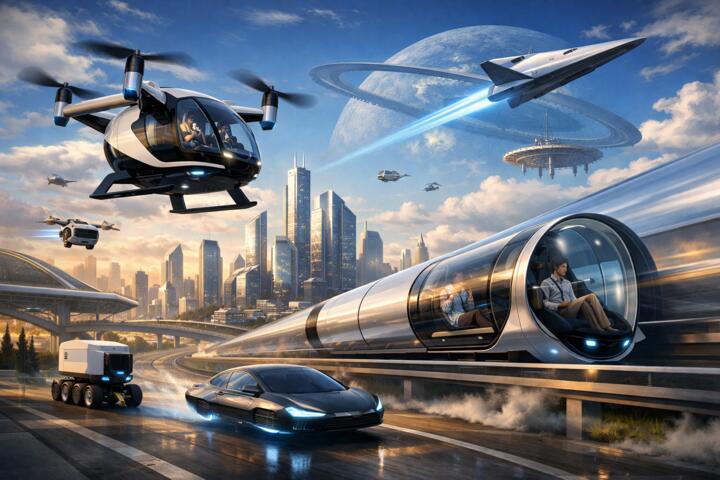
Autonomous vehicles are often treated as the end goal of transport innovation. In reality, they are one component in a much larger ecosystem shift.
Transportation systems are moving from vehicle-centric to system-centric design. The focus is no longer just how a car drives, but how people, goods, data, and energy move together. According to the World Economic Forum, urban mobility systems must reduce emissions, congestion, and inefficiency simultaneously—tasks no single technology can solve alone.
In practice, this means:
-
new vehicle types (air, rail, micro-mobility),
-
digital infrastructure coordinating flows in real time,
-
energy systems tightly integrated with transport.
Transportation Technologies Shaping the Next Era
Electric Vertical Takeoff and Landing (eVTOL) Aircraft
Urban air mobility moves short-distance travel into the sky.
eVTOL aircraft promise:
-
point-to-point travel,
-
zero local emissions,
-
reduced congestion on the ground.
Companies like Joby Aviation are already conducting piloted test flights. Typical target use cases include airport transfers and emergency transport, where time savings justify higher costs.
Key insight: Air mobility succeeds only where airspace regulation, noise management, and ground infrastructure are addressed early.
Hyperloop and High-Speed Tube Transport
Hyperloop systems aim to move passengers and cargo at airline speeds on the ground.
Concepts explored by companies such as Virgin Hyperloop focus on:
-
low-pressure tubes,
-
magnetic levitation,
-
energy-efficient propulsion.
While large-scale deployment remains uncertain, the underlying technologies—advanced materials, linear motors, and vacuum systems—are already influencing rail innovation.
Autonomous Freight and Logistics Networks
Passenger transport gets attention, but freight drives economic value.
Autonomous logistics includes:
-
self-driving trucks on highways,
-
autonomous ships and port equipment,
-
AI-managed rail freight.
Firms like TuSimple demonstrate that long-haul freight automation often delivers ROI sooner than consumer vehicles due to predictable routes and lower regulatory complexity.
Smart Roads and Digital Infrastructure
Future transport depends as much on roads as on vehicles.
Smart infrastructure uses:
-
sensors embedded in roads,
-
adaptive traffic signals,
-
vehicle-to-infrastructure (V2I) communication.
Cities deploying these systems report measurable reductions in congestion and emissions by optimizing traffic flow dynamically instead of relying on fixed schedules.
Mobility-as-a-Service (MaaS) Platforms
Transportation is shifting from ownership to access.
MaaS integrates:
-
public transit,
-
ride-hailing,
-
bike and scooter sharing,
-
payment and planning in one interface.
Platforms piloted in cities like Helsinki show increased public transit usage and reduced private car dependency when systems are designed around user convenience.
Hydrogen and Alternative Energy Transport
Electrification alone cannot decarbonize all transport modes.
Hydrogen fuel cells are gaining traction for:
-
long-haul trucking,
-
shipping,
-
rail in non-electrified regions.
Companies such as Toyota invest heavily in hydrogen as a complement—not a competitor—to batteries.
Pain Points: Why Many Transportation Innovations Fail
1. Technology-First Thinking
Many projects prioritize novelty over integration.
Why it matters:
A fast vehicle is useless without compatible infrastructure and policy.
Consequence:
Expensive pilots that never scale.
2. Fragmented Governance
Transportation crosses city, regional, and national boundaries.
Result:
Regulatory delays, incompatible standards, and stalled deployment.
3. Underestimating Human Behavior
Efficiency does not guarantee adoption.
Real-world behavior—pricing sensitivity, trust, habits—often determines success more than technical performance.
4. Energy and Grid Constraints
Transport electrification increases grid demand.
Ignoring energy planning leads to bottlenecks that limit scale.
Solutions and Recommendations with Practical Detail
Design Transportation as a System
What to do:
Plan vehicles, infrastructure, energy, and software together.
Why it works:
Prevents isolated solutions that fail in real conditions.
In practice:
Cities combining EV charging, traffic management, and public transit data achieve smoother adoption.
Prioritize Freight and Utility Use Cases
What to do:
Start with logistics, emergency services, or fixed routes.
Why it works:
Predictable demand and clear ROI accelerate learning.
Invest in Digital Twins
What to do:
Simulate transport networks before deployment.
Why it works:
Identifies congestion, energy load, and failure points early.
Align Policy Early
What to do:
Engage regulators during pilot design.
Why it works:
Avoids late-stage legal blockers.
Plan Energy Integration
What to do:
Coordinate transport expansion with grid upgrades and storage.
Why it works:
Ensures reliability as electrification scales.
Mini-Case Examples
Case 1: Autonomous Port Operations
Organization: Global shipping terminal
Problem: Congestion and labor constraints
Action:
-
deployed autonomous cranes and vehicles,
-
integrated AI scheduling systems.
Result:
Higher throughput and reduced turnaround times without expanding port footprint.
Case 2: Urban MaaS Rollout
Organization: European city authority
Problem: Declining public transit usage
Action:
-
launched a unified mobility app,
-
bundled pricing across modes.
Result:
Increased public transport adoption and measurable reduction in private car trips.
Comparison Table: Emerging Transport Technologies
| Technology | Primary Benefit | Main Challenge |
|---|---|---|
| eVTOL aircraft | Speed | Regulation, noise |
| Hyperloop-style systems | Ultra-fast ground travel | Cost, scale |
| Autonomous freight | Efficiency | Regulation, safety |
| Smart roads | Reduced congestion | Upfront investment |
| MaaS platforms | User convenience | Coordination |
| Hydrogen transport | Long-range decarbonization | Infrastructure |
Common Mistakes (and How to Avoid Them)
Mistake: Treating pilots as marketing exercises
Fix: Design pilots for scale from day one
Mistake: Ignoring maintenance and operations
Fix: Budget for lifecycle costs
Mistake: Overpromising timelines
Fix: Communicate uncertainty transparently
Mistake: Separating energy and transport planning
Fix: Integrate grid strategy early
FAQ
Q1: Are self-driving cars still important?
Yes, but they are one layer in a broader system.
Q2: Which technology will scale fastest?
Autonomous logistics and smart infrastructure.
Q3: Will flying cars replace ground transport?
No, they will complement it in specific niches.
Q4: Is hyperloop realistic?
Some components are, full systems remain experimental.
Q5: What role does AI play beyond autonomy?
Traffic orchestration, demand prediction, and energy optimization.
Author’s Insight
From observing transport pilots across logistics, urban mobility, and infrastructure, the biggest breakthroughs rarely come from vehicles alone. Success depends on integration—software, energy, regulation, and human behavior working together. The winners will not be the fastest movers, but those who design transportation as a living system rather than a standalone product.
Conclusion
The future of transportation extends far beyond self-driving cars. Electric aviation, autonomous logistics, smart infrastructure, alternative fuels, and digital mobility platforms are converging into a new mobility ecosystem. Organizations that invest early in system-level thinking, policy alignment, and energy integration will shape how people and goods move over the next decade.