Summary
Automation and intelligence are often used interchangeably, but they solve fundamentally different problems. Automation executes predefined actions efficiently, while intelligence adapts, reasons, and improves under uncertainty. This article explains the real difference between automation and intelligence, why confusing them leads to failed AI projects, and how organizations should design systems that use both correctly.
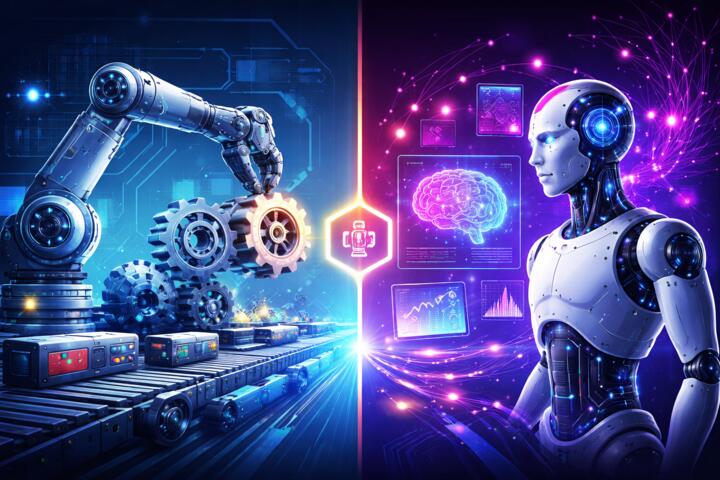
Overview: Automation vs. Intelligence Explained Clearly
Automation is about executing rules.
Intelligence is about making decisions when rules are incomplete or change.
Automation answers: “What should happen when X occurs?”
Intelligence answers: “What is happening, what might happen next, and what should we do?”
A payroll system that calculates salaries is automation.
A system that predicts payroll anomalies, detects fraud, and adapts to new compensation structures is intelligence.
According to McKinsey, over 70% of companies have implemented some form of automation, but fewer than 20% report successful AI-driven intelligence at scale. The gap exists because automation is deterministic, while intelligence operates under uncertainty.
Core Pain Points: Where Organizations Go Wrong
1. Treating Automation as “AI”
Many companies label rule-based systems as artificial intelligence.
Why this matters:
Expectations rise, but system capabilities do not.
Real situation:
An RPA bot fails the moment input data changes format, yet stakeholders expect it to “figure it out.”
2. Scaling Rules Instead of Learning
Organizations often respond to complexity by adding more rules.
Problem:
Rule-based systems become brittle and expensive to maintain.
Consequence:
Each exception creates new technical debt instead of adaptability.
3. Lack of Data Feedback Loops
Automation executes; it does not learn.
Impact:
Without feedback loops, systems cannot improve accuracy or performance over time.
4. Misplaced Trust in “Smart” Systems
Some teams deploy AI without understanding its limits.
Result:
Black-box decisions without explainability create risk, especially in finance, healthcare, and law.
Solutions and Practical Recommendations
Use Automation for Stability, Intelligence for Variability
What to do:
Clearly separate tasks:
-
Automation → repetitive, predictable processes
-
Intelligence → judgment, prioritization, prediction
Why it works:
Each approach excels in different environments.
In practice:
Invoice processing often uses automation for validation and AI for anomaly detection.
Design Hybrid Systems Instead of Pure AI
What to do:
Combine:
-
rule engines for compliance,
-
ML models for prediction,
-
humans for accountability.
Tools and platforms:
-
RPA tools like UiPath
-
ML platforms like Google Vertex AI
-
Decision orchestration layers
Results:
Hybrid systems reduce error rates by 30–50% compared to pure automation.
Measure Adaptability, Not Just Speed
What to do:
Evaluate systems based on:
-
performance under change,
-
recovery from errors,
-
learning over time.
Why it works:
True intelligence reveals itself when conditions shift.
Keep Humans in the Intelligence Loop
What to do:
Define decision boundaries:
-
AI recommends,
-
humans decide.
Example:
In credit scoring, AI predicts risk, but final approval remains human-reviewed.
Mini Case Examples
Case 1: Customer Support Operations
Company: Zendesk
Problem: High volume of repetitive tickets
Solution:
Automation for routing + AI for intent detection
Result:
-
Resolution time reduced by 25%
-
Higher customer satisfaction
Case 2: Enterprise Analytics
Company: IBM
Problem: Static dashboards could not explain anomalies
Solution:
AI-driven analytics layered on automated reporting
Result:
-
Faster root-cause analysis
-
Reduced decision latency
Automation vs. Intelligence Comparison Table
| Dimension | Automation | Intelligence |
|---|---|---|
| Core function | Execute rules | Make decisions |
| Adaptability | Low | High |
| Data usage | Structured inputs | Structured + unstructured |
| Learning | None | Continuous |
| Failure handling | Breaks | Adjusts |
| Best use | Stability | Uncertainty |
Common Mistakes (and How to Avoid Them)
Mistake: Calling automation “intelligent”
Fix: Be explicit about system limits
Mistake: Removing humans entirely
Fix: Keep oversight for high-impact decisions
Mistake: Overengineering AI
Fix: Automate first, add intelligence where needed
Author’s Insight
I’ve worked on systems that collapsed under thousands of brittle rules and others that thrived by combining simple automation with narrow intelligence. The breakthrough always came from clarity: knowing what must never change and what must adapt. Intelligence is not about being smarter—it’s about being flexible under uncertainty. Automation keeps systems efficient; intelligence keeps them alive.
Conclusion
Automation and intelligence are not competing ideas—they are complementary tools. Automation delivers speed and consistency, while intelligence provides adaptability and judgment. Organizations that understand this distinction design systems that scale, evolve, and remain resilient as conditions change.