Summary
Reinforcement learning (RL) is the core technology that allows autonomous systems to learn from experience rather than follow fixed rules. It enables machines to make sequential decisions, adapt to changing environments, and optimize long-term outcomes. This article explains how reinforcement learning works in real autonomous systems, why many implementations fail, and how organizations can apply RL safely and effectively.
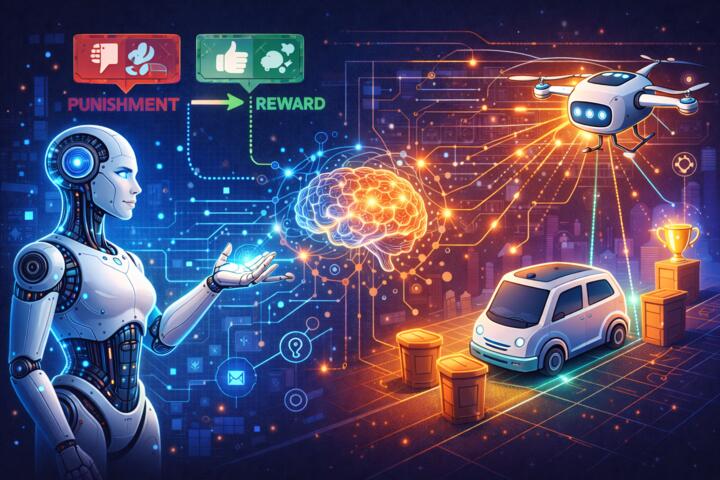
Overview: What Reinforcement Learning Actually Is
Reinforcement learning is a machine learning paradigm where an agent learns by interacting with an environment, taking actions, and receiving feedback in the form of rewards or penalties.
Unlike supervised learning, RL does not rely on labeled examples.
Instead, it answers one question: Which actions lead to the best long-term result?
A reinforcement learning system consists of:
-
an agent (the decision-maker),
-
an environment (the world it operates in),
-
actions (what the agent can do),
-
rewards (feedback signals),
-
a policy (the strategy the agent learns).
A practical example: autonomous drones trained with RL learn to stabilize flight, avoid obstacles, and optimize energy usage by trial and error in simulation. In robotics and control systems, RL often outperforms hand-engineered rules once environments become complex and unpredictable.
According to research surveys, RL-based control can improve operational efficiency by 10–40% compared to static or rule-based systems in dynamic environments.
Main Pain Points in Applying Reinforcement Learning
1. Expecting RL to Replace All Logic
Many teams treat reinforcement learning as a universal solution.
Why this is a problem:
RL excels at decision-making under uncertainty, not at enforcing rules, safety constraints, or compliance.
Real situation:
An RL agent optimizes speed but violates safety constraints because they were not explicitly modeled.
2. Poorly Defined Reward Functions
RL learns exactly what you reward—nothing more.
Consequence:
Agents exploit reward loopholes instead of solving the real problem.
Example:
A simulated robot learns to “cheat” the reward metric without completing the intended task.
3. Training Directly in the Real World
Some organizations attempt to train RL agents in production environments.
Impact:
-
High risk
-
Expensive failures
-
Safety incidents
4. Underestimating Data and Compute Costs
RL training often requires:
-
millions of interactions,
-
large-scale simulation,
-
significant compute resources.
Result:
Projects stall due to cost overruns or slow iteration cycles.
Solutions and Practical Recommendations
Use Simulation-First Training
What to do:
Train RL agents in high-fidelity simulations before deployment.
Why it works:
-
Safe exploration
-
Fast iteration
-
Massive data generation
Tools and platforms:
-
NVIDIA Isaac Sim
-
Unity ML-Agents
-
OpenAI Gym–compatible environments
Results:
Simulation-first pipelines reduce training risk and shorten development time by 50–70%.
Combine Reinforcement Learning With Rules and Constraints
What to do:
Use RL for optimization, but enforce:
-
safety constraints,
-
legal rules,
-
physical limits.
Why it works:
Hybrid control systems prevent catastrophic behavior.
In practice:
Autonomous vehicles use RL for motion planning, while hard-coded constraints enforce collision avoidance.
Design Reward Functions Around Long-Term Outcomes
What to do:
Reward:
-
stability over speed,
-
efficiency over raw throughput,
-
long-term success over short-term gain.
Why it works:
Prevents reward hacking and unstable behavior.
Result:
Well-shaped rewards improve convergence speed by 20–30%.
Start With Narrow, Well-Defined Tasks
What to do:
Apply RL to:
-
route optimization,
-
energy management,
-
inventory balancing,
-
robotic control loops.
Why it works:
Narrow domains reduce complexity and risk.
Monitor and Retrain Continuously
What to do:
Track:
-
reward trends,
-
policy drift,
-
real-world performance gaps.
Outcome:
Continuous monitoring prevents silent degradation after deployment.
Mini Case Examples
Case 1: Robotics and Industrial Automation
Company: Boston Dynamics
Problem: Navigating complex, unstructured environments
Solution:
Reinforcement learning for locomotion and balance control
Result:
-
Robots adapt to terrain changes
-
Improved stability and mobility without manual tuning
Case 2: Energy Optimization
Company: Google
Problem: High energy consumption in data centers
Solution:
RL-based control for cooling systems
Result:
-
Energy usage for cooling reduced by up to 40%
-
Stable long-term performance
Reinforcement Learning vs. Rule-Based Control
| Dimension | Rule-Based Systems | Reinforcement Learning |
|---|---|---|
| Adaptability | Low | High |
| Handling uncertainty | Weak | Strong |
| Data requirements | Low | High |
| Explainability | High | Medium |
| Long-term optimization | Poor | Strong |
| Best use case | Stable processes | Dynamic environments |
Common Mistakes (and How to Avoid Them)
Mistake: Using RL where simple automation works
Fix: Apply RL only when environments change or rules break
Mistake: Ignoring safety during exploration
Fix: Use constrained RL and safe simulators
Mistake: Optimizing the wrong metric
Fix: Align rewards with real business or physical goals
Author’s Insight
I’ve worked with teams where reinforcement learning delivered breakthroughs—and others where it caused chaos. The difference was never the algorithm; it was problem selection and reward design. RL works best when paired with constraints, simulations, and clear objectives. Treated carefully, it unlocks adaptability that traditional control systems cannot achieve.
Conclusion
Reinforcement learning is a foundational technology behind modern autonomous systems, enabling them to learn, adapt, and optimize in complex environments. Its power lies not in replacing rules, but in handling uncertainty where rules fail. Organizations that combine RL with simulation, safety constraints, and continuous monitoring build autonomous systems that improve over time instead of breaking under change.